Author- Sonia Dhillon, CPA, MBA
Choosing the right legal structure is one of the most consequential decisions for any entrepreneur. It is the difference between keeping your hard-earned profits and losing them to unnecessary taxes.
But here is the most common point of confusion: An LLC is a legal entity, while an S Corp is a tax designation. You don’t necessarily have to choose one over the other—you can actually have an LLC taxed as an S Corp.
In this guide, we break down the pros, cons, and the “magic number” where switching to an S Corp finally pays off for your long-term business growth.
1. What is an LLC? (The Flexible Foundation)
A Limited Liability Company (LLC) is the standard for small business owners. It creates a legal wall between your personal assets (your home, car, and savings) and your business liabilities.
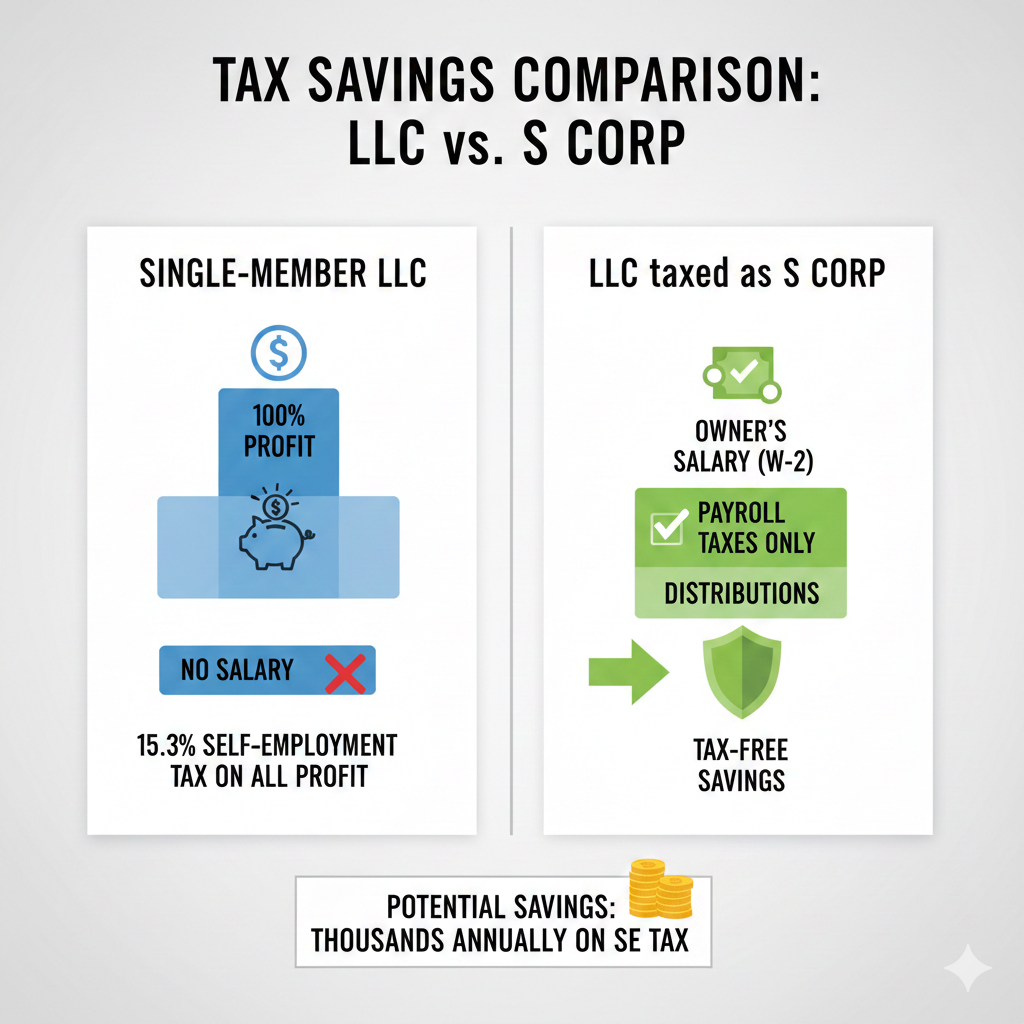
- Taxation: By default, the IRS sees a one-owner LLC as a “disregarded entity.” Profits “pass through” to your personal tax return.
- The Downside: You must pay Self-Employment Tax (15.3%) on 100% of your business profits.
- Best For: Freelancers, side hustlers, and new businesses with modest net profits.
2. What is an S Corp? (The Tax-Saving Powerhouse)
An S Corporation isn’t a type of business you “incorporate” from scratch; it’s a tax status you “elect” via IRS Form 2553.
The primary advantage is the ability to split your income into two buckets:
- Reasonable Salary: You pay yourself a W-2 wage (subject to payroll taxes).
- Distributions: The remaining profit is paid out as a dividend, which is not subject to the 15.3% self-employment tax.
Comparison at a Glance
| Feature | Limited Liability Company (LLC) | S Corp Tax Election |
| Setup Cost | Low (State filing fees only) | Moderate (Payroll setup + IRS filings) |
| Self-Employment Tax | Paid on all net income | Paid on salary only |
| IRS Audit Risk | Generally Lower | Higher (due to salary “reasonableness”) |
| Paperwork | Minimal | High (Meeting minutes, payroll, 1120-S return) |
| Ownership | No limits | Max 100 shareholders (U.S. residents only) |
3. The “Magic Number”: When Should You Switch?
Most tax professionals suggest that the S Corp election starts making financial sense when your business clears $60,000 to $100,000 in annual net profit.
Why? Because running an S Corp comes with administrative overhead. You will need to budget for:
- Payroll Service: To handle your required salary and tax withholdings.
- Business Tax Return: You must file a Form 1120-S, which usually costs more in CPA fees than a standard Schedule C.
- Reasonable Salary Requirements: The IRS requires that you pay yourself a salary consistent with industry standards.
The Math: If your tax savings (the 15.3% you save on distributions) are significantly greater than the cost of payroll and specialized accounting, the S Corp is the winner.
4. Key Pros and Cons
LLC Pros:
- Simplicity: No need to run payroll if you are the only employee.
- Flexibility: You can distribute profits however you like among members.
- Great for Real Estate: LLCs offer better tax treatment for appreciating assets like property.
S Corp Pros:
- Massive Tax Savings: Potential to save thousands per year in self-employment taxes.
- Credibility: A corporate structure can enhance your brand image with certain clients and lenders.
- W-2 Benefits: Easier to prove income for personal loans and contribute to corporate retirement plans.
5. Final Verdict: Which is Right for You?
- Choose a standard LLC if you value simplicity, are just starting out, or your business profit is relatively low.
- Elect S Corp status if your business is consistently profitable and you want to slash your tax bill by shifting a portion of your income to distributions.
6. Frequently Asked Questions (FAQ)
- Can an LLC be an S Corp? Yes. An LLC is a legal entity that can elect S Corp tax status by filing Form 2553 with the IRS.
- Does an S Corp pay self-employment tax? No. An S Corp pays payroll taxes on the owner’s salary, but the remaining distributions are exempt from the 15.3% self-employment tax.
- Is an S Corp better for a single-member LLC? It depends on your profit. Usually, if you earn over $60,000 in net profit, the tax savings of an S Corp outweigh the administrative costs.
- What are the S Corp ownership restrictions? An S Corp cannot have more than 100 shareholders, and all must be U.S. citizens or residents.